The piece outlines the author’s essential outdoor photography gear, including a camera body, a few versatile lenses, a tripod, filters, a drone, and a comfortable backpack. It emphasizes practical preparation, from checking weather to packing batteries and trail essentials.
It also argues that meaningful photos depend more on patience, curiosity, and attention to light and landscape than on expensive equipment. The post closes by encouraging readers to get outside, start with the gear they have, and keep exploring.
Every Adventure Begins with a Camera… and a Little Curiosity
One of the questions I hear most often is, “What camera do you use?”
It’s a fair question, but my answer usually surprises people.
The camera itself is only part of the story.
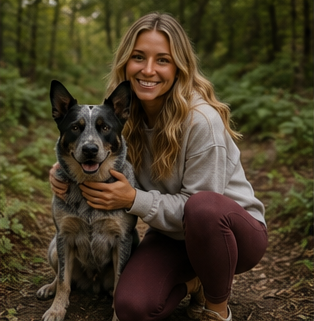
Some of my favorite photographs have happened because I slowed down long enough to notice the morning fog drifting through a valley, the light catching a spider web after a summer rain, or Oakley stopping to watch a deer quietly disappear into the trees. Those moments don’t come from expensive equipment—they come from paying attention.
Still, having reliable gear makes it easier to focus on what really matters: being present and ready when those moments happen.
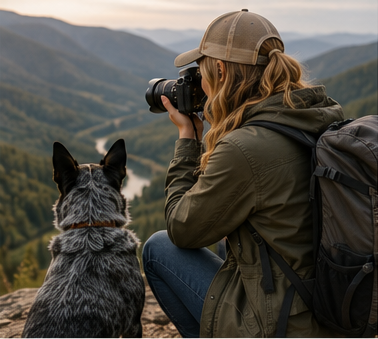
Whether I’m hiking to a mountain overlook before sunrise, photographing waterfalls deep in the forest, or spending a quiet afternoon beside a winding Appalachian stream, there are a few pieces of equipment that always travel with me.
Here’s a look inside my backpack.
My Camera Body
My camera is the heart of every adventure.
When I’m outdoors, I need equipment that can keep up with changing weather, dusty trails, and long days away from civilization. Reliability matters far more than having the newest model on the market.
The features I value most are:
- Excellent image quality
- Good low-light performance
- Fast autofocus
- Weather resistance
- Long battery life
- Comfortable ergonomics
Outdoor photography rarely gives you a second chance. When the light is perfect or wildlife suddenly appears, your camera needs to be ready immediately.
Photography Tip: The best camera is the one you enjoy carrying. A lighter camera that’s always with you will capture more memories than a heavy camera left at home.
The Lenses I Depend On
Different adventures call for different perspectives.
Instead of carrying every lens I own, I usually choose just two or three based on the day’s destination.
Wide-Angle Lens
A wide-angle lens is my favorite choice for:
- Mountain landscapes
- Waterfalls
- Forest scenes
- Sunrise photography
- Scenic overlooks
It allows me to capture the feeling of standing in a place rather than simply documenting it.
Mid-Range Zoom Lens
This is my everyday workhorse.
Whether I’m photographing Oakley on the trail, a rustic cabin, or wildflowers beside a creek, this lens handles nearly everything without constantly changing equipment.
Telephoto Lens
Sometimes the most beautiful moments happen far away.
A telephoto lens helps me photograph:
- Wildlife
- Distant mountain ridges
- Birds
- Autumn colors across valleys
- Details that might otherwise go unnoticed
It also allows me to photograph animals without disturbing them—a practice I always encourage.
My Trusty Tripod
People often think tripods are only for professionals.
The truth is, they’re one of the most useful tools any photographer can own.
A sturdy tripod allows me to:
- Photograph waterfalls with silky smooth water
- Capture dramatic sunrise and sunset scenes
- Shoot long exposures
- Create sharp night sky photographs
- Take self-portraits with Oakley
Many of my favorite landscape photographs simply wouldn’t be possible without one.
Filters That Make a Difference
Filters are small pieces of equipment that have a big impact.
Polarizing Filter
A circular polarizer helps:
- Reduce glare on water
- Deepen blue skies
- Make clouds stand out
- Increase color saturation naturally
It’s probably the filter I use most often.
Neutral Density (ND) Filter
An ND filter acts like sunglasses for your camera.
It allows me to use slower shutter speeds during daylight, creating beautiful movement in waterfalls, rivers, and clouds.
Graduated ND Filter
When photographing sunrises and sunsets, the sky is often much brighter than the landscape.
A graduated filter helps balance the exposure and preserve detail in both.
Looking at the Landscape from Above
Drone photography has completely changed the way I tell stories.
Seeing the Appalachian Mountains from above offers an entirely different perspective than standing on the trail.
I use aerial photography carefully and responsibly, always respecting local regulations, wildlife, and other visitors. Some places prohibit drone use, and in those areas I simply enjoy the scenery from the ground.
Not every adventure needs an aerial view—but when conditions allow, it can reveal patterns and landscapes that are impossible to appreciate from eye level.
The Backpack That Carries It All
A comfortable backpack might be the most underrated piece of outdoor gear.
Mine needs to do several things well:
- Protect camera equipment
- Distribute weight comfortably
- Keep gear organized
- Handle changing weather
- Provide quick access to essentials
After several miles on the trail, comfort becomes just as important as storage.
The Small Things That Make a Big Difference
The gear that rarely appears in photographs is often the gear I appreciate the most.
Here’s what always finds a place in my pack:
- Extra batteries
- Memory cards
- Lens cleaning cloth
- Rain cover
- Headlamp
- First aid kit
- Multi-tool
- Water bottle
- Trail snacks
- Notebook and pen
- Lightweight rain jacket
And, of course…
Dog treats.
Oakley has an amazing ability to know exactly when it’s snack time.
Preparing Before I Leave Home
One lesson I’ve learned over the years is that great adventures usually begin the night before.
Before heading out, I make it a habit to:
- Charge every battery
- Format memory cards
- Check the weather forecast
- Clean my lenses
- Pack extra water
- Download offline trail maps
- Confirm sunrise and sunset times
- Double-check that Oakley’s gear is packed too
A little preparation means I can spend less time worrying and more time enjoying the outdoors.
It’s Not About the Gear
As much as I enjoy photography equipment, the truth is that gear alone doesn’t create meaningful images.
Patience does.
Curiosity does.
Being willing to wake up before sunrise, hike one more mile, wait for the light to change, or simply pause and appreciate your surroundings—that’s what creates photographs that tell a story.
Some of my favorite images were made on ordinary days with ordinary equipment.
The adventure mattered far more than the camera.
Looking Ahead
Over the coming months, I’ll be sharing more about the gear I use, how I prepare for photography trips, and the techniques that help me capture the beauty of Appalachia in every season.
If you’re just getting started, don’t worry about having the “perfect” setup.
Get outside.
Take your camera.
Explore somewhere new.
The rest will come with time.
What’s in Your Backpack?
I’d love to hear from you.
What’s the one piece of gear you never head outdoors without?
Leave a comment below and let me know. You might even inspire me to try something new on my next adventure.
See you on the trail.
— Emily Carter